
 Contact Us

The adoption of recycled PET resin over virgin plastic directly affects packaging manufacturers, supply chain economics, and global environmental sustainability.
Fragmented recycling infrastructure can hinder economies of scale and restrict the supply of high-grade recycled Polyethylene Terephthalate (rPET). Understanding how packaging design influences collection costs, material sorting, and processing methodologies is essential for optimizing recycled PET products across consumer markets.
Energy, Resource Consumption, and Production Economics
Manufacturing virgin plastic requires substantial natural resources: approximately 900 litres of petrol, 180 cubic metres of water, and 14,000 kilowatt-hours of energy per tonne of plastic produced.
In contrast, producing one tonne of recycled plastic requires:
-
2 tonnes of post-consumer plastic.
-
1 cubic metre of water.
-
950 kilowatt-hours of energy.
By utilizing reprocessed PET material as feedstock, packaging manufacturers achieve significant energy savings and lower greenhouse gas emissions compared to virgin resin processing.
Eco-Design Impact on Recycled PET Packaging Costs
Recycling a PET bottle keeps it out of the landfill, but it does much more than that.
Recycled PET resin is a valuable manufacturing feedstock that can be reprocessed and reused in bottles over and over again.
Recycling instead of landfilling, then using that reprocessed PET material as a raw material for new products, greatly reduces the greenhouse gas and carbon emissions impact and requires less overall energy to produce the new product.
Over 1.4 billion pounds of clean recycled PET went back into the production of new products—such as those pictured above—in the U.S. and Canada, about three times what was used 10 years ago.
An important aspect is linked to design of packaging of edible oil. In fact the design of the containers has a direct and significant impact on the costs of collection, selection and recycling.
The choice of materials, colours, format and other design-related components determines if a specific type of packaging will have a post-consumption value if recycled (and how much), or if it will bring additional disposal costs.
Non-recyclable packaging brings an additional net cost that can even reach 300-350 dollars per tonne collected compared to packaging that is easily recycled.
To offer just one example, opaque PET bottles have a low level of recyclability compared to transparent bottles.
READ ALSO: "PET recycling: features, colour of bottles made with post consumer PET"
Studies on the recycling capacity of plastic related to design
A study by APR (the Association of Plastic Recyclers) has analysed the different types of packaging.
The design choices for the packaging analysed by APR include the shape as well as the use of labels, handles, ink and direct printing, glue, closure and covering of closure and accessories (valves, pumps, triggers, etc.).
The study estimated that the use of shrink-wrap covering labels, or sleeves, on PET bottles costs around 44-88 dollars for every tonne of recycled PET and from 2- 4 cents for every 500 grammes of processed product.
Specific studies have shown that during selection and recycling there is a decrease of mixed plastic materials that can reach 15% depending on the design features including the format.
Packaging that is less than 400-700 millimetres in size (such as caps of various types and small containers such as probiotic vials) are generally incinerated as waste.
APR has stated that it intends to develop solutions to intercept and recycle this flow and to lower waste through design improvement.
These measures could bring economic benefits of 50-70 dollars per tonne of collected mixed plastic packaging.
There is a number of key overarching principles that are appropriate for all PET bottles.
These include:
- Design for ease of separation and removal of materials such as closures and labels from PET bottles to allow for ease and efficiency of recycling;
- Avoidance of using materials that are known to significantly contaminate and reduce quality of PET;
- Use of fewer packaging materials on PET bottles to allow for ease and efficiency of recycling.
The choice of the most suitable polymer
Polymer materials that are not often used for packaging are rarely recycled as the quantities are not sufficient to benefit from economies of scale in the selection and recycling phase.
These polymers may also obstruct the recycling of more commonly used polymers as is the case when PVC or PLA enter the recycling flow for PET.
READ ALSO: "PET BOTTLE FOR EDIBLE OIL"
PET recycled products: the use of pigments
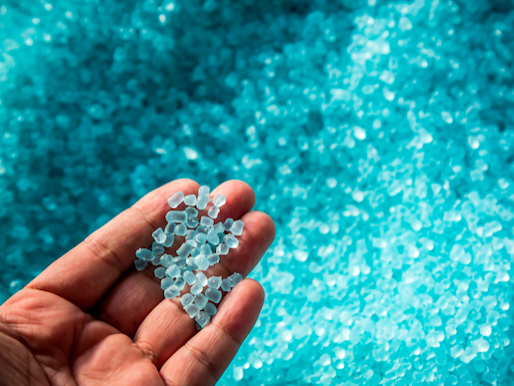
Colouring plastics with pigments reduces the value of recycled materials up to 100-300 dollars per tonne.
The switch from the extensive use of packaging in dark or covering colours (such as those for PET with opacifer agent Titianium dioxide - TiO2) to transparent or lighter colours would have the opposite effect.
A number of manufacturers of detergents have chosen not to colour product containers made from high density polyethylene (HDPE) to maintain the post-consumption value of the material for as long as possible.
In addition, the elimination of carbon black pigments (used in 1.5%-2% of packaging by weight) would reduce the loss of these forms of packaging that are currently discarded in infra-red ray automatic selection plants.
The recovery of clear PET facilitates the creation of the highest value recyclate and typically allows for closed loop bottle-to-bottle recycling.
The use of colourants should be minimised as much as possible.
Translucent tints that are very light shades of blue or green are acceptable, as these colours alter the colour of recycled PET in a minor way and help to offset any yellowing that may occur during the recycling process. Strong tints for example mid to dark-blue, green and brown should be avoided whenever possible.
Where strong colours are contemplated for shelf appeal then consider using alternative methods like sleeves, however these must be easily separated from the bottle prior to any automatic sorting operations.
Tints are always preferable to opaque colours as they can become dispersed and do not cause haziness in recycled PET as opaque colours do. Black colour should be avoided where possible.
Very small amounts of black colourant can significantly discolour a stream of clear / light blue PET recyclate.
- Coloured PET waste has a lower monetary value than clear (typically 50% lower).
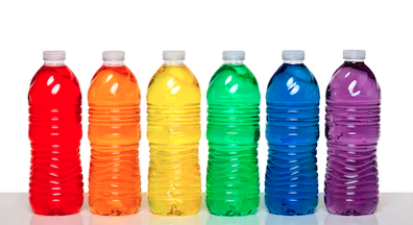
- The use of strongly pigmented bottles (black, white and colours) has a significant negative impact on the quality of recycled PET since presence of small amounts of coloured fragments can discolour recycled PET during extrusion.
- The presence of coloured PET also increases the losses of clear/light blue PET during flake sorting as for every coloured PET flake a clear PET flake is typically lost.
Fillers or masterbatch additives for example titanium dioxide, that can be used for opacity or for lowering the cost and polymer content of the plastic should be avoided or their use minimised.
Fillers can change the density of the plastic and can also contaminate the recycled PET stream and impact the clarity of the rPET resin.
PET recycled products: focus on additives
The design guidelines for recycling have shown that certain additives used in the packaging production have a detrimental effect on recycling processes.
The effects vary depending on the polymers.
They range from the discolouration of the recycled material to consequences for the density of the plastic material that translates into the inevitable loss of material in the recycling phase.
Conclusions
To prevent packaging design choices from having an ongoing negative impact on the recycling system it is vital that ongoing collaboration is created between the packaging designers at the top of the chain and the subjects post-consumption at the bottom.
Frequently Asked Questions about Recycled PET Products
How do recycled PET products compare to virgin plastics in energy and resource consumption?
Producing one tonne of recycled PET requires 950 kWh of energy and 1 cubic metre of water, compared to 14,000 kWh of energy, 180 cubic metres of water, and 900 litres of petrol for virgin plastic production.
How does container design impact recycled polyethylene terephthalate (rPET) production plant cost efficiency?
Poor packaging design (such as using opaque colors, non-separable shrink sleeves, or incompatible polymers) adds sorting costs of $300–$350 per tonne and reduces recyclate yield by up to 15%.
Why are clear PET bottles preferred over dark or opaque containers for recycling?
Clear and light-blue PET bottles yield high-value transparent recyclate suitable for closed-loop bottle-to-bottle reprocessing. Opaque or heavily pigmented bottles reduce material value by $100–$300 per tonne and can discolour recycled PET streams.
What design principles improve the recyclability of recycled pet packaging?
Key design principles include selecting transparent or light-tinted resins, using easily separable labels and caps, eliminating carbon black pigments, and avoiding incompatible polymers like PVC or PLA.